| GROUP RISK INCOME PLAN (GRIP) INSURANCE WITHOUT THE HARVEST PRICE OPTION |
GRIP is revenue insurance paying indemnities when county revenue is below a
revenue guarantee. GRIP has two options: GRIP without the harvest revenue option (GRIP-NoHR) has a guarantee
that will not increase while GRIP with the harvest revenue option (GRIP-HR) has a guarantee that will increase
if the harvest price is above the base price. This fact sheet describes GRIP-NoHR.
Revenue guarantee under GRIP-NoHR
The GRIP-NoHR revenue guarantee equals 1) the expected county yield times 2)
the expected price times 3) a farmer-chosen coverage level. Each factor determining the revenue guarantee is
described below:
1. Expected county yield. The expected county yield is determined for each
crop insured in a county. The expected county yield is based on a history of county yields.
2. Expected price. The expected price is based on Chicago Board of Trade (CBOT)
futures contracts. The December CBOT contract is used for corn and the November contract is used for soybeans.
The settlement prices of these contracts are averaged for the month of February.

3. Coverage level. The farmer chooses the coverage level in a range
of between 70 and 90 of expected revenue.
In 2005, corn in Champaign County, Illinois has a 164 bu. expected yield.
If the expected price is $2.50, the revenue guarantee for the 90 percent coverage level is $369 per acre
(see Figure 2)

County revenue under GRIP-NoHR
County revenue is used to calculate indemnity payments.
County revenue equals actual county yield times a harvest price. County yields are calculated
be the U.S. Department of Agriculture, National Agricultural Statistics Service (NASS).
NASS usually releases county yields by March in the year after the crop is harvested.
As a result, payments on GRIP are not made until the year after harvest.
Harvest prices are based on Chicago Board of Trade (CBOT)
futures contracts. For corn, the harvest price equals the average of settlement prices of
the December corn contract during the month of October. For soybeans, the harvest price
equals the average of settlement prices of the CBOT November soybean contract during the
month of October. There are limits to the moves on harvest prices. The harvest price on
corn can not be above the base price by more than $1.50 per bu. or be below the base price
minus $1.50 per bu. For soybeans, the limit is $3.00 per bu.

For a county yield of 100 bu. and a harvest price of $2.00,
county revenue is $200 per acre (100 bu. x $2.00).
Indemnity payments under GRIP-NoHR
GRIP-NoHR pays an indemnity when county revenue is below the revenue guarantee.
The indemnity payment equals the percent revenue shortfall times a protection level.
The farmer must choose the protection level from a range.
For the Champaign county example having a $369 revenue guarantee
(see Figure 2), a 160 bu. county yield and a $2.00 price gives county revenue of $320 per acre,
resulting in a revenue shortfall of 13.3 percent (($369 revenue guarantee - $320 county revenue)/$369
revenue guarantee). If a $600 protection level is chosen, the indemnity payment equals $80 per acre
($600 protection level x 13.3 percent revenue shortfall).
Choices under GRIP-HR
Farmers have two choices under GRIP:
1. Coverage level, and
2. Protection level.
Coverage level: Higher coverage levels increase the revenue guarantee.
In the Champaign County example (see Figure 2), an 85 percent coverage level has a $349 per acre revenue
guarantee (164 expected county yield x $2.50 projected price x 85 percent coverage level). A 90 percent
election has a $369 per acre guarantee.
Higher coverage levels also have higher indemnity payments when county revenue
is below the revenue guarantee. In the Champaign county example, a $58 per acre indemnity is paid when county
revenue is $250 under an 85 percent yield election. For a 90 percent election, the indemnity payment is $77,
an increase of $19 per acre from the 85 percent election (see Figure 4).

Protection level: A higher protection level has higher indemnity payments
than does a lower protection level election. The protection level must be chosen from within a range.
The maximum protection level is the expected yield times the expected price times 1.5. The minimum protection
level is 60% of the maximum. For a 164 bu. expected yield and a $2.50 expected price, the maximum protection
level is $615 per acre (164 x $2.50 x 1.5) and the minimum is $369 per acre ($615 x .60).
Differences in indemnity payments, given a 90 percent coverage level,
are shown in Figure 5. At a $300 county revenue, a $75 indemnity payment results from a $400 protection level.
A $600 protection level has a $122 indemnity payment, a $47 increase over the $400 protection level.

GRIP-NoHR premiums
Per acre premiums depend on the county of the insured crop,
and the coverage and protection levels chosen by the farmer. Higher coverage and protection
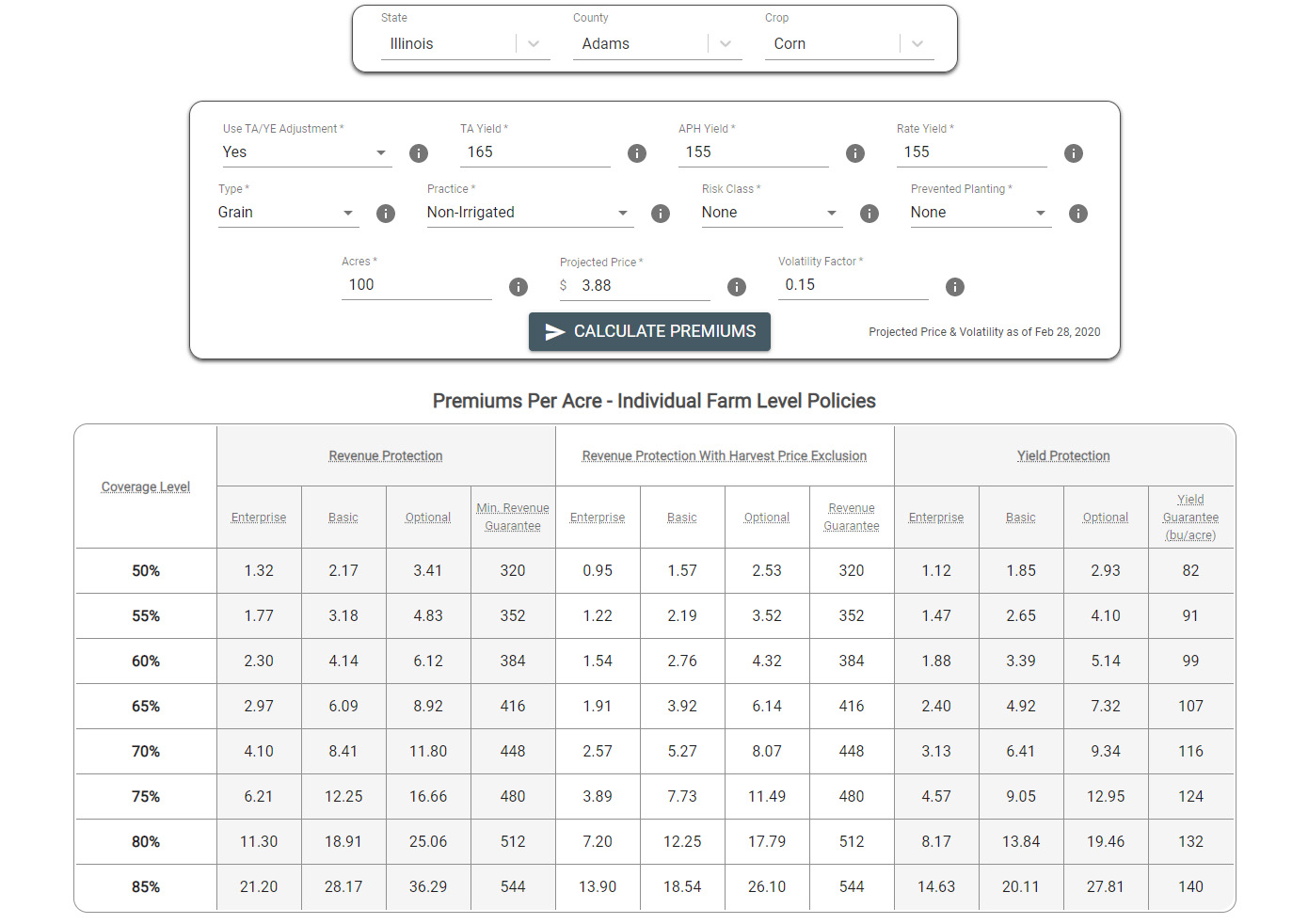
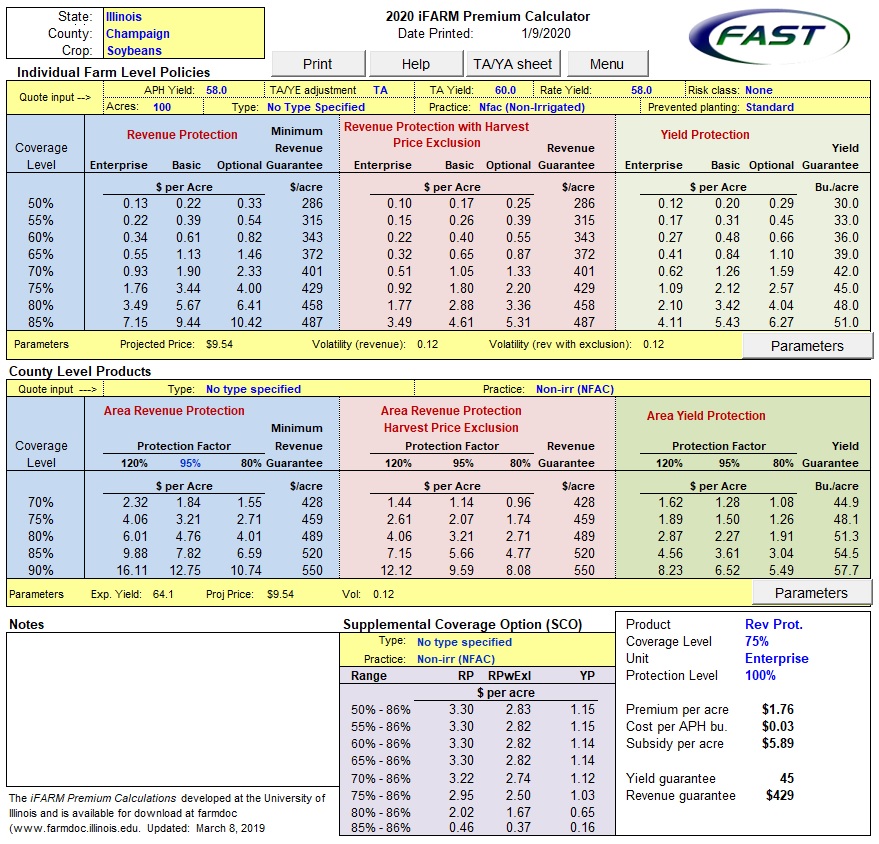
levels result in higher premiums. Premiums are available from the iFARM Premium Calculator
available in the crop insurance section of farmdoc (www.farmdoc.uiuc.edu).
Other information
The "Group Crop Insurance Plan" document provides additional descriptions
of GRIP-HR. In addition, the document compares the group products. This document is available in the crop
insurance section of farmdoc.
Limitations
Group products do not have replant or prevented planted provisions.
Group products do not pay quality or price discounts that may be available for farm-level products,
such as sometimes occurs with Aflatoxins.
Prepared by: Gary Schnitkey, Department
of Agricultural and Consumer Economics, University of Illinois
Updated: February 2006
|